
Products / Riken Keiki
Riken Keiki: fixed gas detectors for hazardous areas
Riken Keiki has been making gas detection instruments since 1939. Socrate is an authorised distributor for the full range of fixed detectors, including the SD-1 and SD-3 series, and integrates them into the Fire & Gas architectures of industrial plants for continuous monitoring of combustible gases, toxic gases and oxygen in hazardous areas.
About Riken Keiki
Riken Keiki was founded in Tokyo in 1939, within the RIKEN research conglomerate, in response to accidents in coal mines and explosions on tanker ships. Eighty-seven years later, thanks to continuous innovation and research, it is one of the most reliable manufacturers of gas detection instruments.
Contact us if you are interested in this brand
If you are looking for Riken Keiki solutions, contact the Socrate technical team: we will help you choose and integrate the instrument best suited to your area.
The series distributed by Socrate
Riken Keiki fixed detectors for combustible gases, toxic gases and oxygen.
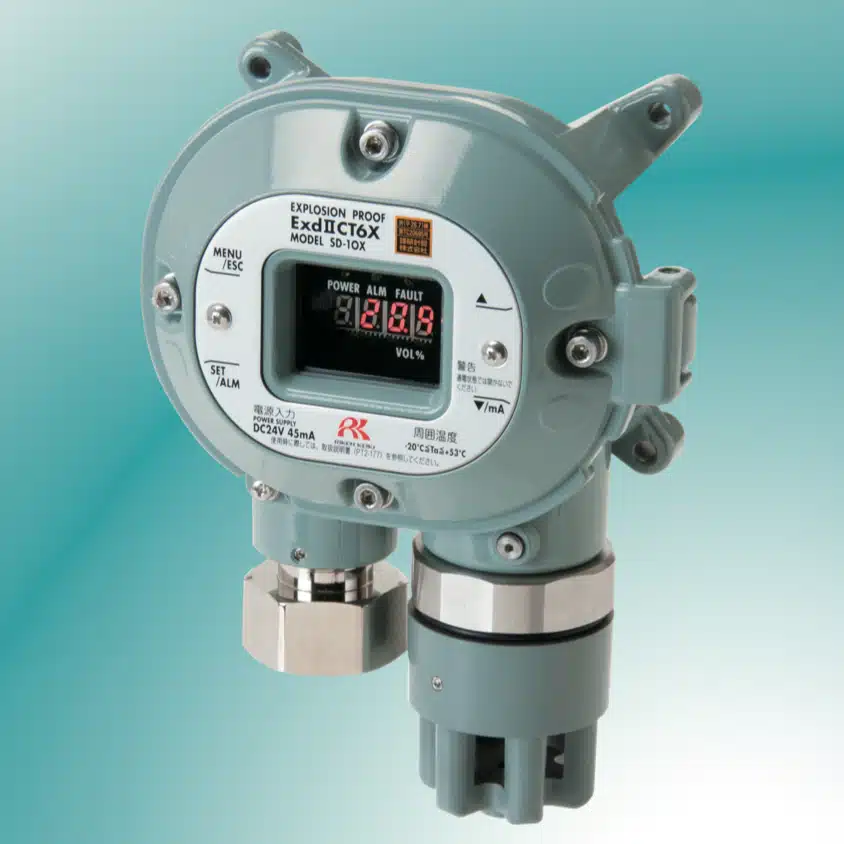
The SD-1 series detects combustible gases, hydrogen sulphide, carbon monoxide and oxygen in hazardous areas. It weighs about 2 kilograms and takes up 148 × 167 mm on the wall.
It is the choice for standard installations, where weight and footprint matter and the gas is among those covered by the six available models. For harsher environments or gases outside the list, the answer is the SD-3 series.
At a glance
| Detected gases | Combustible, hydrogen sulphide, carbon monoxide, oxygen |
| Measuring principles | Catalytic combustion, new ceramic, non-dispersive infrared, semiconductor, electrochemical, galvanic cell |
| Weight and size | From 2.0 to 2.5 kg, 148 mm wide |
| Protection | IP65 equivalent, flameproof enclosure |
| Output | 3-wire 4-20 mA, power and signal on the same cable; HART 7 on specific versions |
| Certifications | ATEX, IECEx, Japan Ex, MED on specific models, CE marking, SIL2 according to IEC 61508 on SD-1RI, SD-1EC and SD-1OX |
| Hydrogen and acetylene | Suitable for atmospheres containing hydrogen and acetylene thanks to the explosion-proof enclosure |
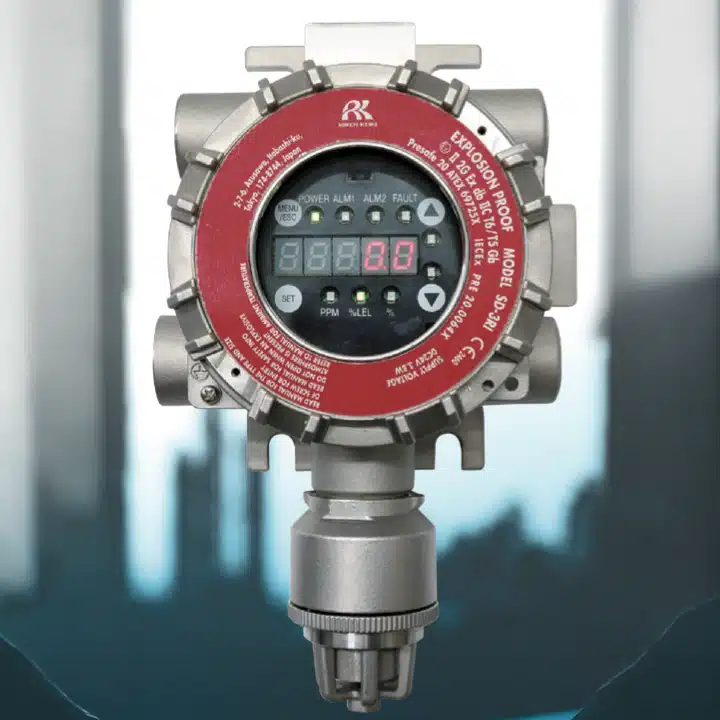
The SD-3 series continuously detects combustible gases, toxic gases and oxygen in hazardous areas. Stainless steel housing, IP66/67 protection, operation from -40 to +70 °C.
It is the series Socrate is focusing its Riken Keiki supply on, because it covers the cases where a standard detector does not hold up: cold, corrosion, washdowns, inaccessible installation points and gases outside the usual lists.
At a glance
| Detected gases | Combustible, toxic and oxygen: 76 sensor, gas and range combinations |
| Measuring principles | Non-dispersive infrared, new ceramic catalytic, semiconductor, hot-wire semiconductor, electrochemical |
| Housing | SCS14 stainless steel, equivalent to AISI 316, IP66/67 protection |
| Temperature | From -40 to +70 °C under ATEX and IECEx certification |
| Outputs | Three alternative configurations at order: 4-20 mA with HART 7 (standard), with HART 7 plus relay contacts, or with Modbus RS-485 |
| Certifications | ATEX (DEKRA 24ATEX0017X), IECEx, performance EN 60079-29-1 and EN 45544, MED and SIL2 on specific models |
| Installation | Diffusion, aspiration, remote sensor up to 20 metres, duct insertion |
SD-1 or SD-3: how to choose
Neither series is a budget version of the other. They answer different plant conditions.
| SD-1 | SD-3 | |
|---|---|---|
| Weight | 2.0-2.5 kg | 6.0-7.6 kg |
| Protection | IP65 | IP66/67, AISI 316 equivalent stainless steel |
| Temperature | -20 / +60 °C | -40 / +70 °C |
| Outputs | 4-20 mA, HART | 4-20 mA HART 7, RS-485, 3 relay contacts |
| Alarm thresholds | One | Two, configurable |
| Sampling | Diffusion, aspiration with accessory | Diffusion, aspiration, remote up to 20 m, in-duct |
| Sensor diagnostics | Self-diagnostics at power-on | Self-diagnostics plus remaining life estimate |
| Gases covered | 6 models | 76 sensor, gas and range combinations |
The rule in one line. Choose the SD-1 when the installation is standard, weight and footprint matter and the gas is among those covered. Choose the SD-3 when the environment is harsh, when digital integration beyond 4-20 mA is needed, when the sensor must be mounted where nobody can climb up for maintenance, or when the gas is not among the six covered by the SD-1.
If the specification does not make clear which condition prevails, it is time to talk: the choice depends on the area classification and the installation point, not on the model.
What sets Riken Keiki instruments apart
The sensor tells you when it is about to expire
F-family sensors, fitted on the SD-3 series, diagnose their own degradation and, during calibration, estimate their remaining life by comparing the calibration history. When the sensor is nearing the end of its life, the instrument gives a warning: replacement becomes part of the maintenance schedule instead of arriving as a failure. Riken Keiki declares a three-year warranty on F sensors, with at least one annual inspection and with exclusions that depend on the individual sensor.
Toxic gases that general-purpose instruments cover poorly
The SD-3 series detects carbon disulphide, carbonyl sulphide, ethylene oxide, fluorinated compounds, vinyl chloride and dimethylacetamide, as well as the most common combustible and toxic gases. These are gases that general-purpose manufacturers handle on request, or not at all.
Built-in intrinsic safety barrier
The SD-3ECB, SD-3DECB and GD-3ECB models combine a flameproof enclosure and intrinsic safety in the same body (Ex db ia). The built-in barrier removes the sintered filter in front of the sensor, which retains highly adsorbent toxic gases and distorts the reading. Without it, the response is more accurate.
Five measuring principles, one supplier
Riken Keiki covers non-dispersive infrared, new ceramic catalytic, semiconductor, hot-wire semiconductor and electrochemical detection with its own technology. In a plant that monitors different gases, this means one point of contact, one calibration approach and one type of spare part in stock.
Hydrogen with selective sensors
Selective hydrogen sensors on two technologies, new ceramic catalytic and hot-wire semiconductor, with ranges from 500 ppm to 100 %LEL. A sensor for deuterium is also available. Where hydrogen coexists with hydrocarbons, this is the difference between a useful alarm and a false one.
Where they are used
The Riken Keiki fixed detectors distributed by Socrate are mainly used in:
- Refineries and petrochemical plants
- Chemical and pharmaceutical process units
- Terminals and storage depots
- Gas compression and treatment systems
- Utility tunnels and confined spaces
- Marine and offshore installations, for MED-certified models
- Plants that handle or produce hydrogen
The suitability of a model depends on the area classification, the operating temperature and the gas to be detected. The complete ATEX and IECEx classes, model by model, are in the datasheets.
What Socrate adds
We choose the instrument, not the brand
Socrate is an authorised distributor of the main Fire & Gas device brands, including Riken Keiki. This is why we can recommend the instrument with the best price-performance ratio for the specific request and for the area where it will be installed. Sometimes the answer is Riken Keiki. Sometimes it is not, and we say so.
Engineering, not just supply
We work from the design stage: analysis of hazardous areas and release sources, detection architecture, choice of technologies, safety logic, integration with DCS and ESD. The Fire & Gas Business Unit builds systems in accordance with EN 60079-29-1 and, where required, SIL 3 architectures according to IEC 61508.
Service and calibration
On equipment supplied by Socrate we carry out commissioning, functional testing, scheduled maintenance and calibration. We also handle spare parts for Riken Keiki devices we did not sell: if you have installed instruments and need a sensor, we can help.
Forty years on the same plants
Since 1984 Socrate has worked exclusively in Oil & Gas, energy and the process industry. Headquarters in Rodano, workshop in Augusta, operating offices in Libya, Tunisia, Egypt and Greece. Management system certified to ISO 9001, 14001, 45001 and 50001 since 2010.
Frequently asked questions
No. Socrate is an authorised Riken Keiki distributor, not an exclusive one, for the SD-1 and SD-3 series fixed gas detectors. The scope covers fixed detection: Riken Keiki portable detectors are not part of the Socrate catalogue. On these instruments Socrate provides selection, engineering, supply, service and calibration.
The SD-1 is compact, weighs about 2 kg, has IP65 protection and operates between -20 and +60 °C. The SD-3 weighs from 6 to 7.6 kg, has an IP66/67 stainless steel housing, operates between -40 and +70 °C, offers digital outputs in addition to 4-20 mA and uses sensors that estimate their own remaining life.
Yes. The SD-1 and SD-3 series have ATEX and IECEx certification with a flameproof enclosure. For the SD-3 series, the EU type-examination certificate is DEKRA 24ATEX0017X, issue 3 of April 2026, marked II 2G Ex db ia IIC T4 Gb. The exact class varies by model and detected gas, from Ex db IIC T4 Gb to Ex db IIC T6 Gb.
The frequency depends on the gas, the environment and the plant procedures. Riken Keiki requires at least one annual inspection as a condition of the three-year warranty on SD-3 series F sensors. Socrate calibrates the instruments it supplies, in Italy and at its offices abroad.
Yes. The SD-1 and SD-3 series datasheets are available in Italian and English and can be freely downloaded from the product pages; certificates are in their original language. For help reading a specification or checking a tender requirement, you can contact our engineers.
You will be contacted within 24 hours.
We are ready to meet your needs
Contact