Home / Fire and Gas / Riken Keiki / Riken Keiki SD-3, fixed gas detector for harsh environments

Riken Keiki SD-3, fixed gas detector for harsh environments

Sottotitolo

Divisions:

Product Description

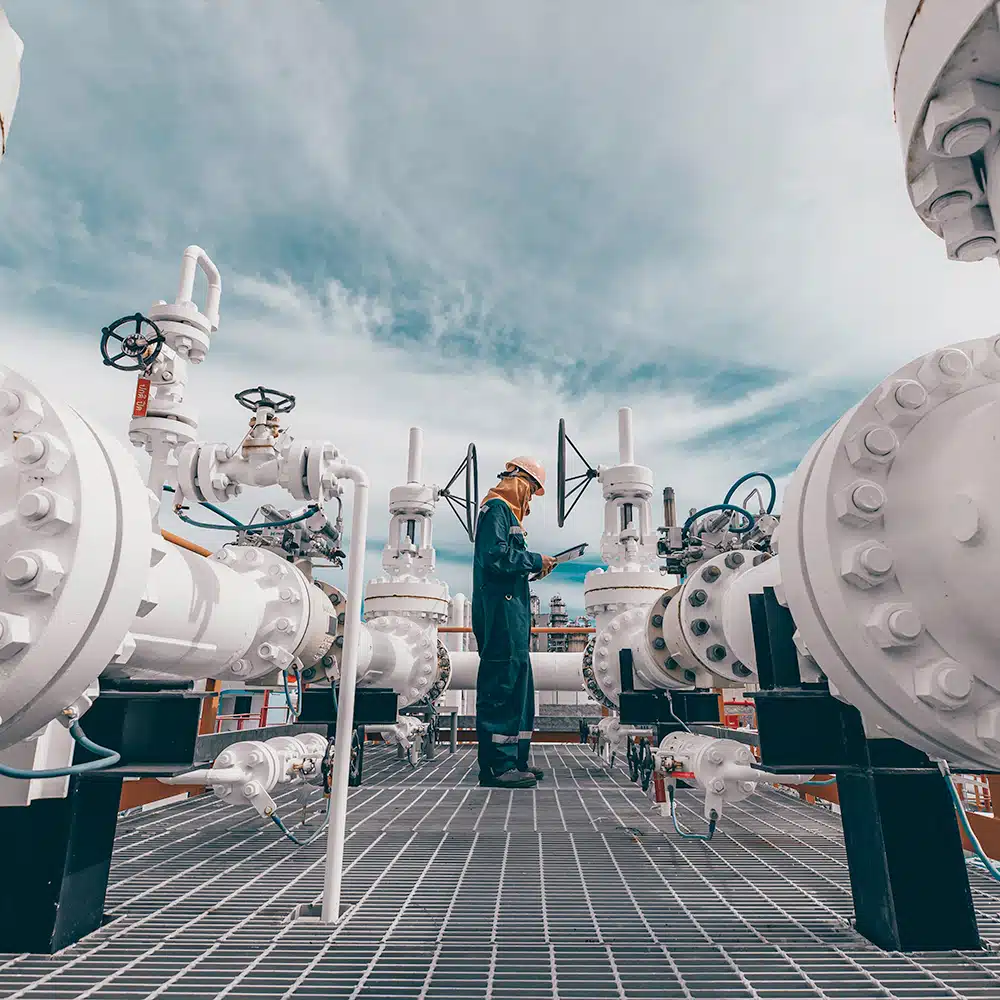
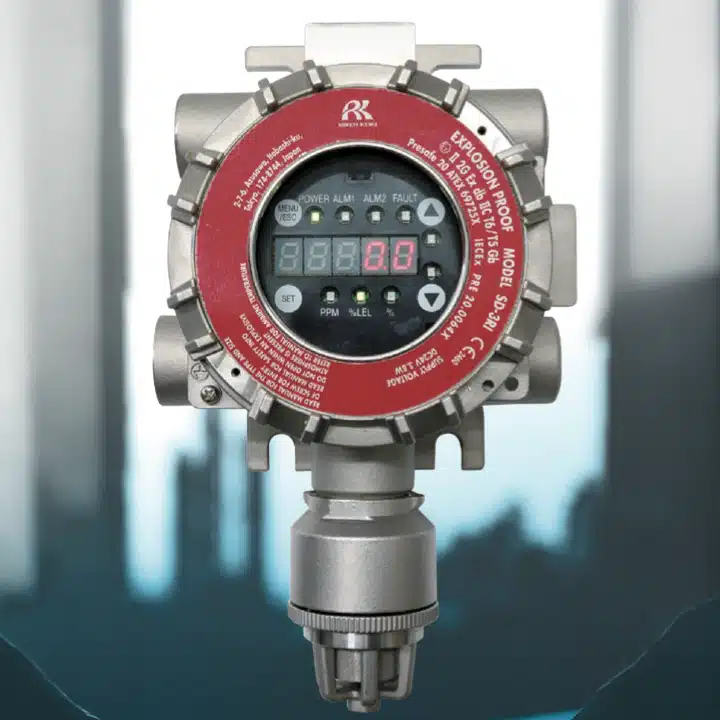
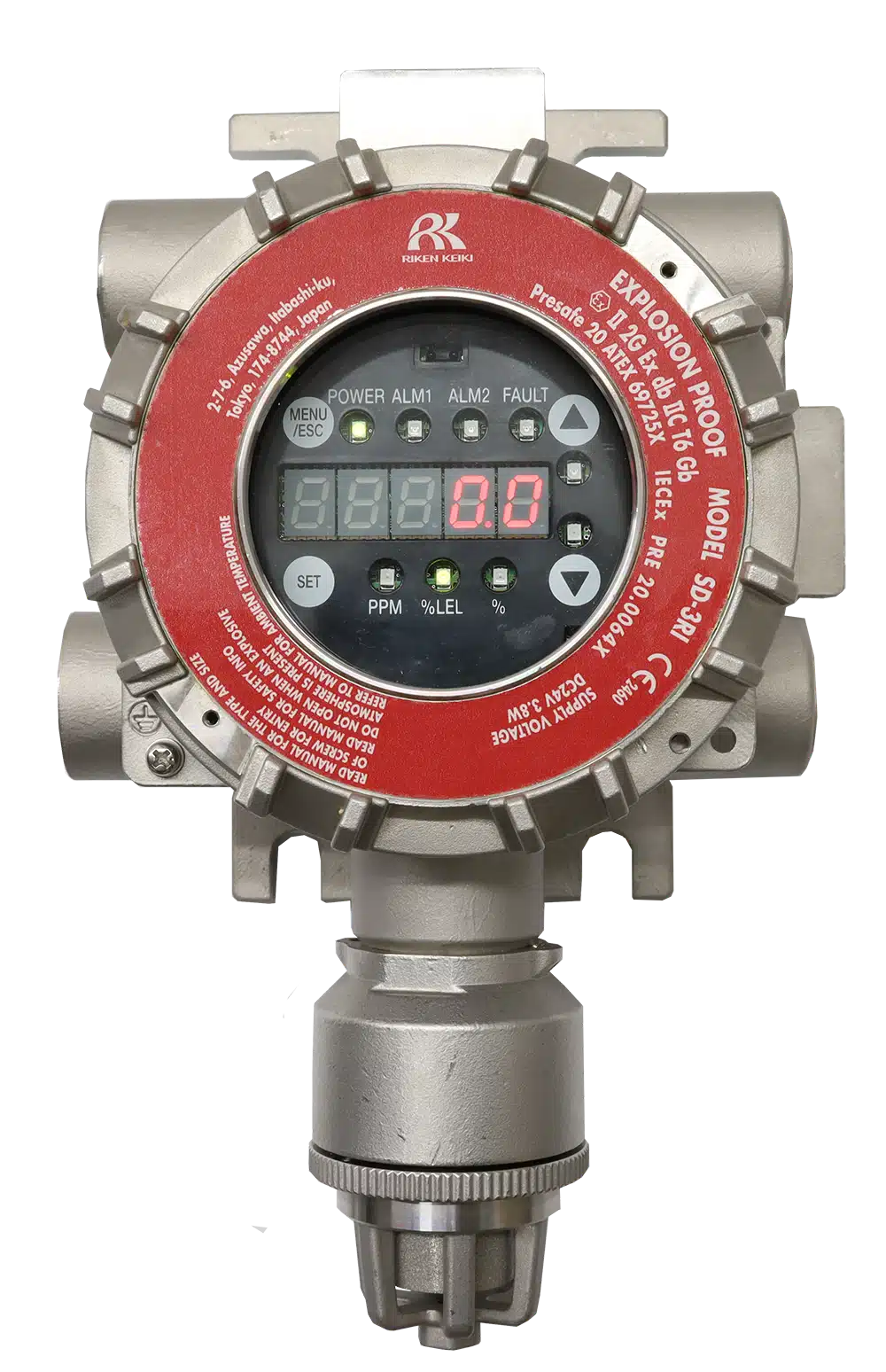
The SD-3 series continuously detects combustible gases, toxic gases and oxygen in hazardous areas. Stainless steel housing, IP66/67 protection, operation from -40 to +70 °C.

It is the series Socrate is focusing its Riken Keiki supply on, because it covers the cases where a standard detector does not hold up: cold, corrosion, washdowns, inaccessible installation points and gases outside the usual lists.

At a glance

Detected gases Combustible, toxic and oxygen: 76 sensor, gas and range combinations
Measuring principles Non-dispersive infrared, new ceramic catalytic, semiconductor, hot-wire semiconductor, electrochemical
Housing SCS14 stainless steel, equivalent to AISI 316, IP66/67 protection
Temperature From -40 to +70 °C under ATEX and IECEx certification
Outputs Three alternative configurations at order: 4-20 mA with HART 7 (standard), with HART 7 plus relay contacts, or with Modbus RS-485
Certifications ATEX (DEKRA 24ATEX0017X), IECEx, performance EN 60079-29-1 and EN 45544, MED and SIL2 on specific models
Installation Diffusion, aspiration, remote sensor up to 20 metres, duct insertion

Key features

F sensors with remaining-life estimation

The detector diagnoses the degradation of its own sensor by analysing the characteristic parameters of the measuring principle, such as zero-output drift or electrolyte level. During calibration it estimates the remaining life by comparing the history of previous calibrations, and signals when the sensor is approaching replacement.

The warning travels as a digital signal over HART or RS-485, so it reaches the control room without a site visit.

Riken Keiki declares a three-year warranty on F sensors, with at least one annual inspection. Some sensors are excluded.

Two-level alarm

Each instrument manages two configurable alarm levels in the combinations high/high-high, high/low and low/low-low.

This separates the warning threshold from the action threshold without doubling the number of installed instruments.

Stainless steel housing for aggressive environments

The body is made of SCS14 stainless steel, equivalent to AISI 316, with IP66/67 protection against powerful water jets and temporary immersion.

It withstands plant washdowns, salty atmospheres and corrosive environments where painted aluminium degrades.

Remote sensor up to 20 metres

In the remote configuration, the SD-3SC main unit stays in an accessible position while the GD-3 series sensor head can be installed up to 20 metres away, with AWG16 shielded twisted cable.

It is designed for points where gas must be detected but no operator can climb up for maintenance: under a floor slab, inside a cabinet, at the top of a column. An optional kit allows direct insertion into a duct.

Integrated intrinsic safety on ECB models

The SD-3ECB, SD-3DECB and GD-3ECB models combine flameproof enclosure and intrinsic safety (Ex db ia IIC T4 Gb). The integrated barrier removes the sintered metal filter in front of the sensor.

That filter retains highly adsorbent toxic gases, slowing down or distorting the reading. Without the filter, the response is more accurate.

Digital integration, not just 4-20 mA

The output is configured at order, choosing one of three options:

  1. 4-20 mA with HART 7 communication, standard configuration
  2. 4-20 mA with HART 7 plus three changeover relay contacts (alarm 1, alarm 2, fault)
  3. 4-20 mA with Modbus communication over RS-485

The three configurations are mutually exclusive: choosing Modbus means giving up HART. It is a decision to take at design stage, because changing it later means replacing the instrument.

Typical applications

  • Refineries and petrochemical plants, where stainless steel and a wide temperature range are needed
  • Chemical plants with adsorbent toxic gases (carbon disulphide, ethylene oxide)
  • Hydrogen production, storage and use, with selective sensors
  • Terminals and depots with frequent washdowns and salty atmospheres
  • Offshore and marine installations
  • Ducts and ventilation systems, with the insertion version
  • Inaccessible measuring points, with the remote sensor version

Models and selection criteria

The model is chosen according to the gas and the sampling method. The letter D in the code indicates the aspiration version.

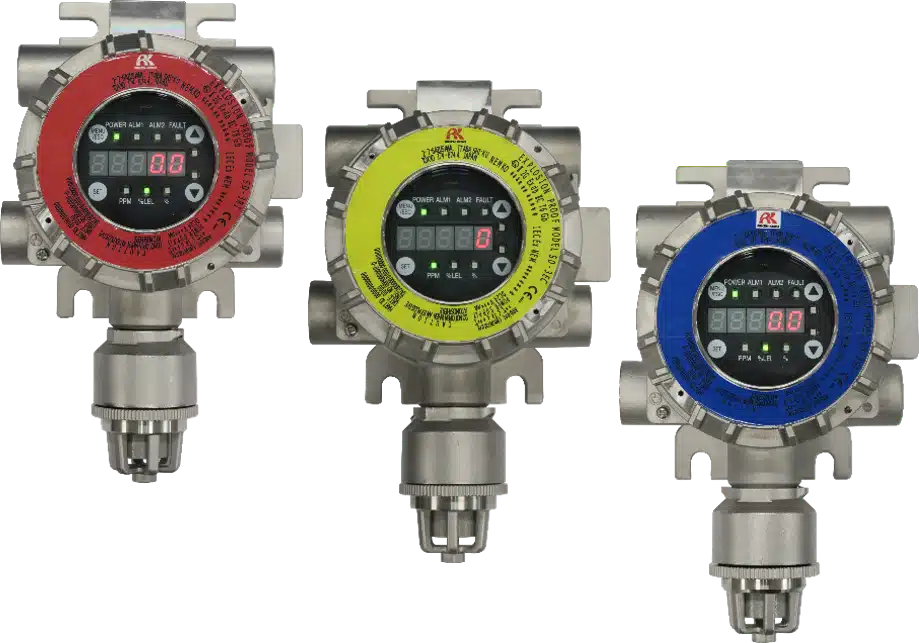
DiffusionAspirationPrincipleGasATEX classSIL
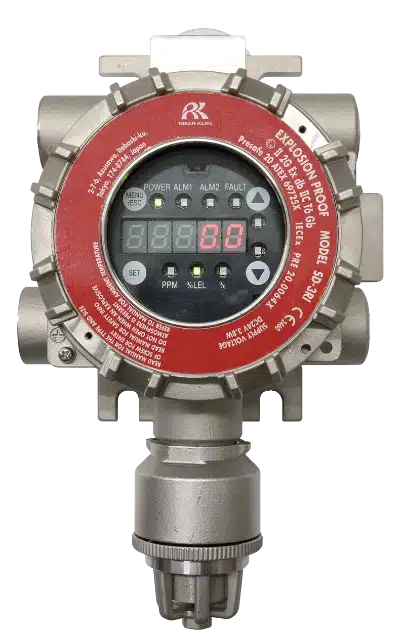
SD-3RISD-3DRINon-dispersive infraredCombustible, toxicEx db IIC T6/T5 GbSIL2, SIL3 with redundancy
SD-3NCSD-3DNCNew ceramic catalyticCombustibleEx db IIC T5/T4 GbSIL2, SIL3 with redundancy
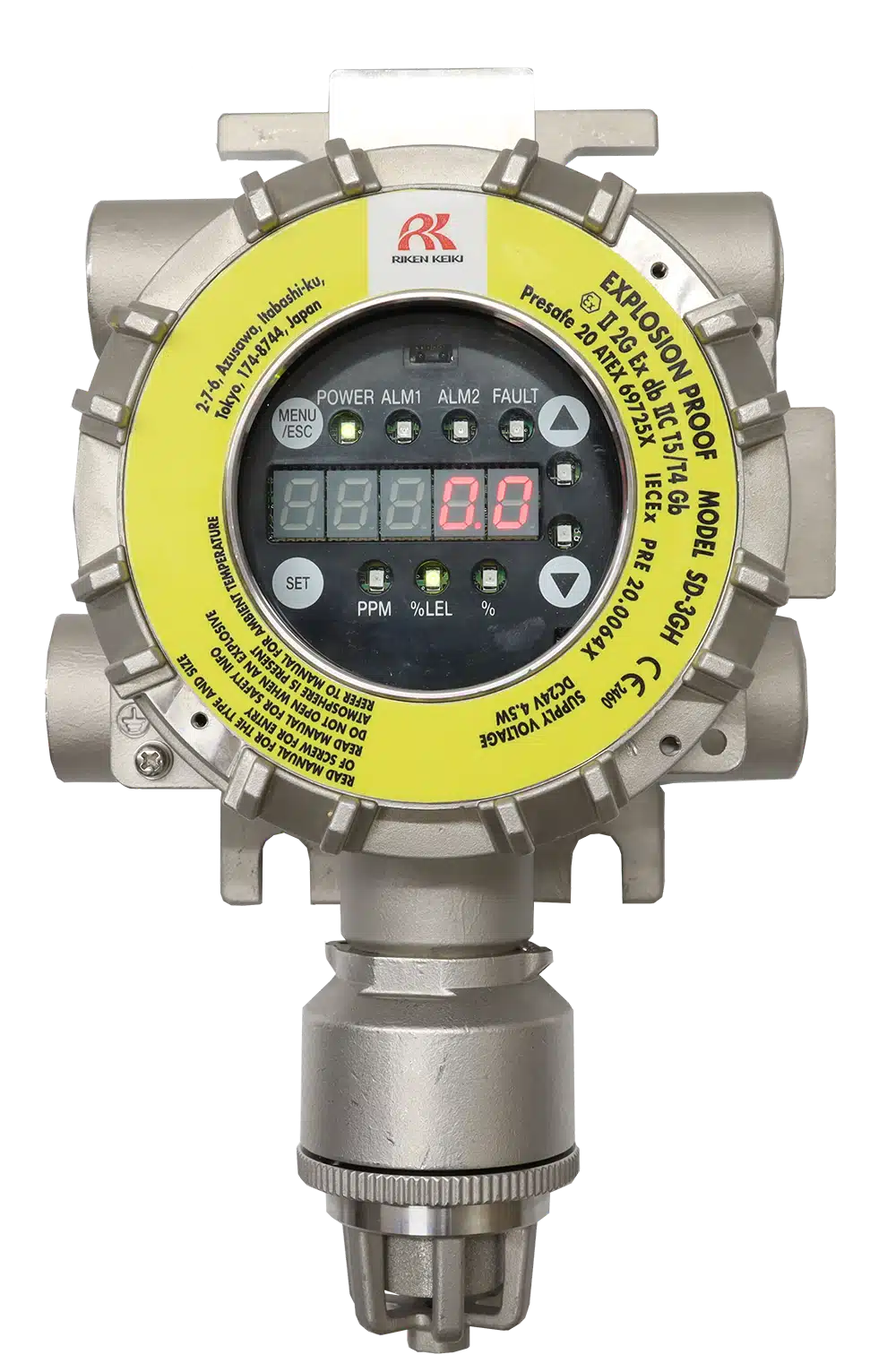
SD-3GHSD-3DGHSemiconductorCombustible, toxicEx db IIC T5/T4 GbNot certified
SD-3GHSSD-3DGHSSemiconductorCarbon disulphide onlyEx db IIC T6/T4 GbNot certified
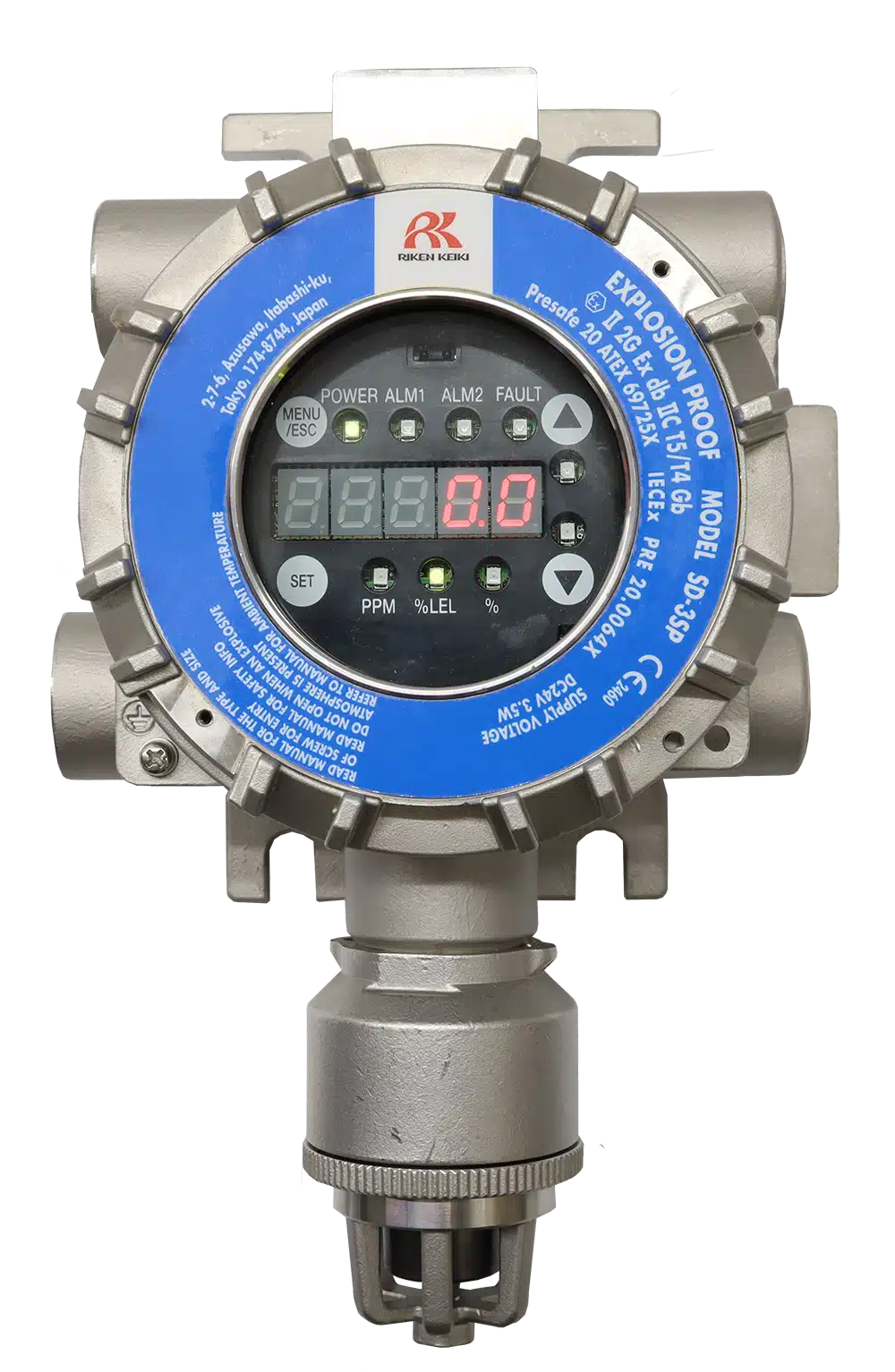
SD-3SPSD-3DSPHot-wire semiconductorCombustible, toxicEx db IIC T5/T4 GbNot certified
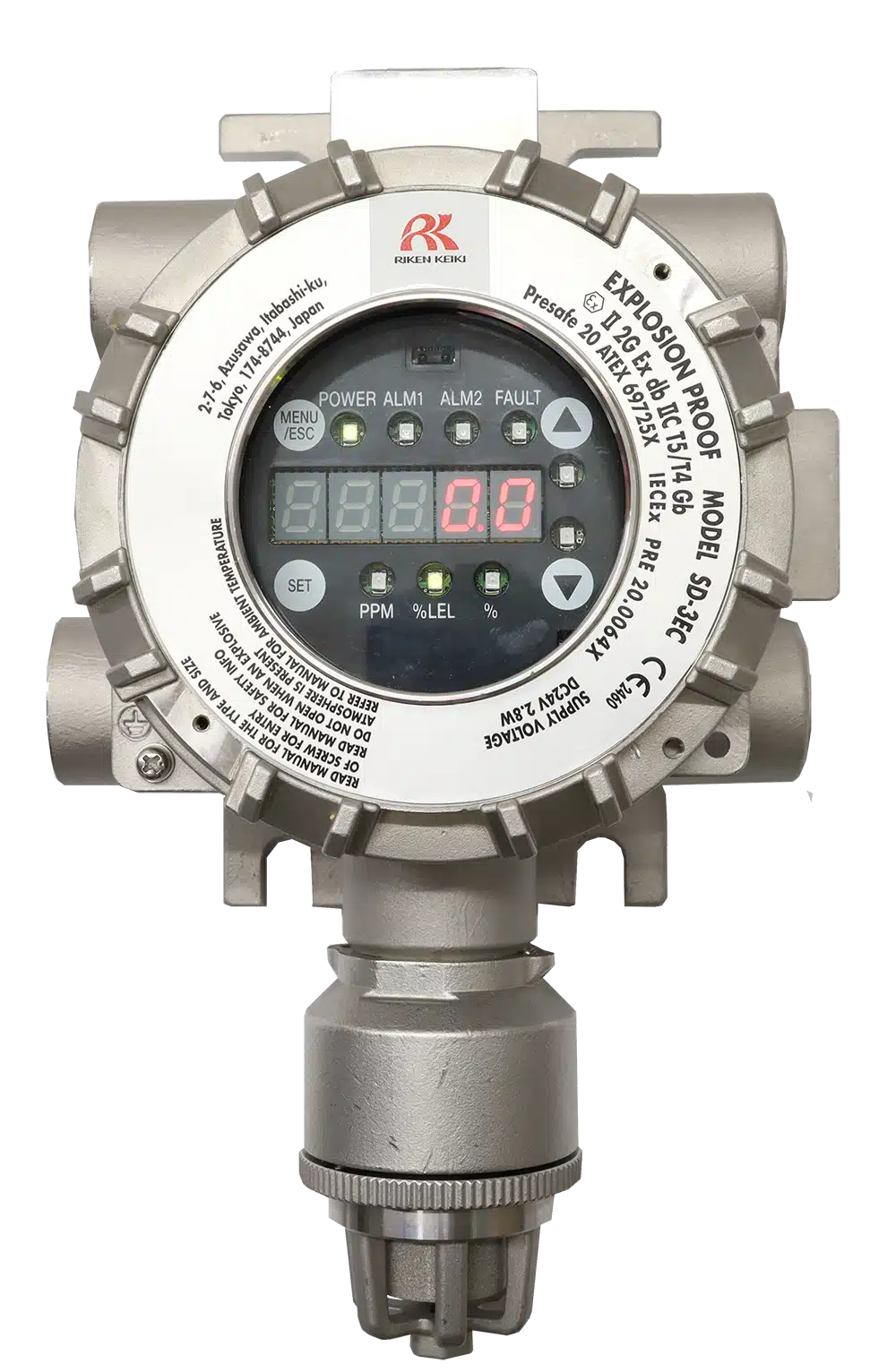
SD-3ECSD-3DECElectrochemicalToxic, oxygenEx db IIC T4 GbSIL2, SIL3 with redundancy
SD-3ECSSD-3DECSElectrochemicalHydrogen sulphide onlyEx db IIC T4 GbSIL2, SIL3 with redundancy
SD-3ECBSD-3DECBElectrochemical with barrierAdsorbent toxic gasesEx db ia IIC T4 GbCertification in progress

Remote version: SD-3SC main unit combined with a GD-3 series sensor head, available in the same eight variants.

How to choose, in practice

  • The gas is a common combustible and SIL is required: SD-3RI (infrared) or SD-3NC (catalytic)
  • Hydrogen must be detected without responding to other combustibles: SD-3NC or SD-3SP with selective sensor
  • The gas is toxic and highly adsorbent: SD-3ECB, for the integrated barrier without sintered filter
  • Oxygen monitoring is required: SD-3EC
  • Hydrogen sulphide only: SD-3ECS
  • Carbon disulphide only: SD-3GHS
  • Limited installation space or inaccessible point: D aspiration version, or SD-3SC with remote head

Infrared and catalytic are not equivalent. Infrared does not get poisoned and works without oxygen; catalytic covers gases that infrared cannot see, such as hydrogen. The choice depends on the gas and on the atmosphere at the measuring point.

Detectable gases

The SD-3 series uses F family sensors. An extract by measuring principle:

Non-dispersive infrared (IRF)Methane from 100 %LEL to 100 vol%, propane, isobutane, ethylene, isobutylene, n-hexane, butadiene, carbon dioxide in six ranges from 2,000 ppm to 10 vol%.
New ceramic catalytic (NCF)Methane, ethane, propane, isobutane, acetylene, ethylene, propylene, butadiene, n-octane, toluene, acetone, ethyl alcohol, methyl alcohol, isopropyl alcohol, vinyl chloride, dimethylacetamide. Selective hydrogen from 2,000 ppm to 100 %LEL.
Semiconductor (SGF)Carbonyl sulphide, carbon disulphide, ethylene oxide, hydrogen sulphide.
Hot-wire semiconductor (SHF)Methane, isobutane, ethylene, acetylene, propylene, n-hexane, octane, carbon monoxide, fluoromethane, difluoromethane, hexafluoro-1,3-butadiene, 1,2-dichloroethylene, isopropyl alcohol. Selective hydrogen and deuterium from 500 ppm to 2,000 ppm.
Electrochemical (ESF)Hydrogen sulphide 30 ppm in high-humidity version and 100 ppm, nitrogen dioxide 15 ppm, oxygen 25%.

Since the January 2026 catalogue edition, electrochemical sensors for carbon monoxide 150 ppm, ammonia in the 75, 150 and 400 ppm ranges and chlorine in the 1.5, 3 and 10 ppm ranges are also available.

Ammonia and chlorine require the models with integrated intrinsic safety barrier, i.e. SD-3ECB, SD-3DECB or GD-3ECB: they are highly adsorbent gases and the sintered filter would distort the reading.

For gases or ranges not listed, the complete list of F sensors includes 76 combinations. Contact us with the gas and range you need.

Dimensions and weight

ConfigurationDimensions W × H × DWeight
Diffusion, standard171 × 277 × 127 mm6.7 kg
Diffusion, tall version171 × 322 × 127 mm7.3 kg
Aspiration, standard171 × 289 × 127 mm7.0 kg
Aspiration, tall version171 × 334 × 127 mm7.6 kg
SD-3SC main unit171 × 193 × 127 mm6.0 kg
GD-3 remote sensor125 × 195 × 88 mm, or 125 × 240 × 88 mm3.0 kg, or 4.0 kg

Indicative values, cable glands excluded.

Power consumption by model

ModelMaximum consumption
SD-3RI3.8 W
SD-3NC, SD-3GH, SD-3GHS4.5 W
SD-3SP3.5 W
SD-3EC, SD-3ECS2.8 W
SD-3ECB3.1 W
SD-3SC (remote main unit)5.0 W
GD-3 remote sensorFrom 1.0 to 2.0 W depending on model

Specifications common to the whole series

Display5-digit 7-segment LED, 3 indicator lamps (red, green, yellow)
Gas alarmTwo levels (H-HH, H-L or L-LL)
Self-diagnosticsSystem fault (E-9), sensor fault (E-1)
WarningsSensor remaining life, clock diagnostics, communication diagnostics
Standard output4-20 mA DC non-isolated linear with HART 7, max load 600 Ω, max resolution 250 divisions
Optional outputModbus over RS-485 half duplex, as an alternative to HART
Optional contactsSPDT, 3 contacts, 250 V 2 A AC or 30 V 1 A DC on resistive load
Aspiration flow rate0.4-1.5 L/min
Power supply24 V DC (18-30 V DC)
Cable glandsM25 × 1.5 on ATEX and IECEx; optional NPT 3/4, NPT 1/2, M20 × 1.5 adapters
Housing materialSCS14 stainless steel, equivalent to AISI 316
ProtectionIP66/67 equivalent
TemperatureFrom -40 to +70 °C on ATEX and IECEx; from -20 to +70 °C on Japan Ex
HumidityFrom 0 to 95% RH non-condensing, subject to individual sensor limits
Ex enclosureFlameproof; flameproof plus intrinsic safety on ECB models
CE markingATEX, EMC, RoHS directives
CommunicationHART 7

Certifications

Explosion protection

EU type-examination certificate DEKRA 24ATEX0017X, edition 3, issued on 7 April 2026 by DEKRA Certification B.V., notified body 0344, under Directive 2014/34/EU.

MarkingII 2G Ex db ia IIC T4 Gb and II 2G Ex db [op is] IIC T4 Gb
Applied standardsEN IEC 60079-0:2018 + A11, EN 60079-1:2014 + A11, EN 60079-11:2012, EN 60079-28:2015 + A11
IECExIECEx certificate of conformity FMG 22.0011X, edition 6, issued on 13 April 2026 by FM Approvals, status Current

The certificate lists six specific conditions of use, including the prohibition on repairing flameproof joints and the limits on electrostatic discharge. They are available in full in the certificate, which can be downloaded below.

Detection performance

EU type-examination certificate FM22ATEX0019X, issued on 15 April 2026 by FM Approvals Europe Ltd, notified body 2809.

StandardScope
EN 60079-29-1:2016 + A1:2022 + A11:2022Combustible gases
EN 45544-1:2015 and EN 45544-3:2015Toxic gases
EN IEC 62990-1:2022 + A11:2022Workplace atmospheres, toxic gases
FM 6320, CSA C22.2 No. 60079-29-1, ANSI/FM/UL 60079-29-1Combustible gases, North American market
FM 6340, ANSI/ISA 92.00.01Toxic gases, North American market
EN 50271:2018Apparatus using software and digital technologies

The IECEx certificate FMG 22.0011X covers the same performance tests at international level, for SM-type flammable and toxic gas detectors.

Oxygen and EN 50104. The SD-3 series is not certified to EN 50104, the performance standard for oxygen detectors. If the specification explicitly requires EN 50104 for oxygen monitoring, an alternative model must be evaluated: talk to our engineers before specifying.

Marine use

EC type-examination certificate Bureau Veritas 82838/A0 MED, module B of Directive 2014/90/EU on marine equipment, notified body 2690. Issued on 1 April 2026, valid until 1 April 2031. Category: fixed equipment for oxygen analysis and gas detection, category 3, explosive atmospheres.

Three limits to consider in the specification:

  • Partial coverage. The MED certificate only covers models SD-3RI, SD-3NC, SD-3DRI, SD-3DNC, SD-3SC, GD-3RI and GD-3NC.
  • Combustible gases only. EN 50104 and IMO MSC.1/Circ.1370 do not apply, because these models are not intended for oxygen detection and measurement.
  • No wheelmark with the certificate alone. The production control module D, E or F required by Annex II of the directive is also needed.

Performance declared in the MED certificate: accuracy ±5% of full scale, response time t(90) within 60 seconds, temperature from -40 to +70 °C, IP66/67 protection, 24 V DC power supply from 18 to 30 V.

Functional safety and directives

ScopeReference
Functional safetySIL2 according to IEC 61508 on SD-3RI, SD-3NC, SD-3EC and SD-3ECS; SIL3 with redundant architecture. Certification in progress on SD-3ECB
DirectivesATEX, EMC, RoHS
National explosion protectionJapan Ex

In aspiration configurations, the associated external unit must also be SIL certified for the function to maintain the declared level.

The flameproof examination covers construction, not detection performance: the performance certificates cover that.

Frequently asked questions

What is the minimum operating temperature of the SD-3 series?

In the ATEX and IECEx certified versions the SD-3 series operates from -40 to +70 °C. In the Japan Ex version the lower limit is -20 °C. Some sensors have narrower ranges: the semiconductor sensor works from -20 to +65 °C and the hot-wire sensor from -30 to +70 °C.

Is the SD-3 series SIL2 certified?

Models SD-3RI, SD-3NC, SD-3EC and SD-3ECS are SIL2 certified according to IEC 61508, and reach SIL3 with redundant architecture. Models SD-3GH, SD-3GHS and SD-3SP are not SIL certified. Certification of the SD-3ECB is in progress. The level of the safety function must in any case be verified case by case on the actual architecture.

How long does an SD-3 sensor last?

Riken Keiki declares a three-year warranty on F sensors, provided that at least one annual inspection is carried out. Some sensors are excluded. The instrument estimates the remaining life during calibration and signals when the sensor is approaching replacement.

Can the sensor be installed away from the detector?

Yes. The remote configuration of the SD-3 series combines the SD-3SC main unit with a GD-3 series sensor head. The head can be installed up to 20 metres away, with AWG16 shielded twisted cable. It is designed for measuring points that are inaccessible for maintenance. An optional kit allows direct insertion into a duct.

Does Socrate provide service on SD-3 detectors?

Socrate performs commissioning, functional testing, scheduled maintenance and calibration on the Riken Keiki SD-3 detectors it has supplied. Spare parts, sensors included, are also handled for Riken Keiki devices purchased elsewhere. The service operates in Italy and at the foreign branches in Libya, Tunisia, Egypt and Greece.

See also
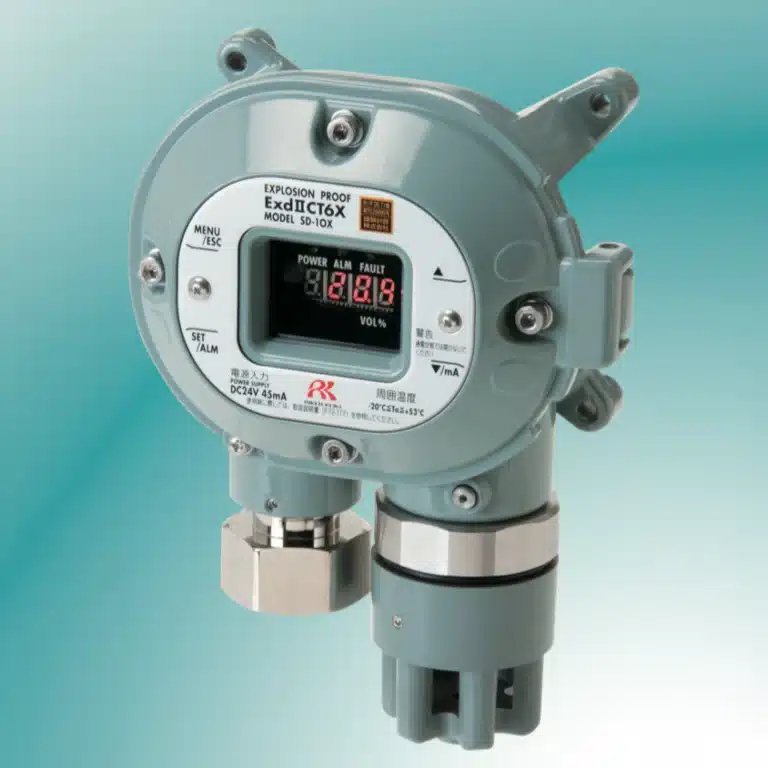
Riken Keiki SD-1 series fixed gas detector

Riken Keiki SD-1

Compact fixed gas detector: 2 kg, IP65, six models for standard installations.

Discover →

Riken Keiki logo

Riken Keiki

The manufacturer, the series distributed by Socrate and how to choose between SD-1 and SD-3.

Discover →

Gas detection in industrial plants

Fire & Gas Business Unit

Design, supply and integration of gas and flame detection systems.

Discover →

Documentation

Datasheets are available in English and Italian; certificates are in their original language. For help reading a specification or checking a tender requirement, contact our engineers.

Are you interested in this product?

Fill out the form

You will be contacted within 24 hours.

Go to the contact page

Contact

Scroll to Top